What Is a Parlay and How Do Multi‑Leg Bets Pay Out?
That’s the simple answer. Now let’s break it down step by step so you actually understand how multi-leg bets work, how payouts are calculated, and whether parlays are smart or just exciting.
Would you rather win $90 with a solid 50% chance — or chase $600 with less than a 15% chance of winning?
What Is a Parlay in Sports Betting?
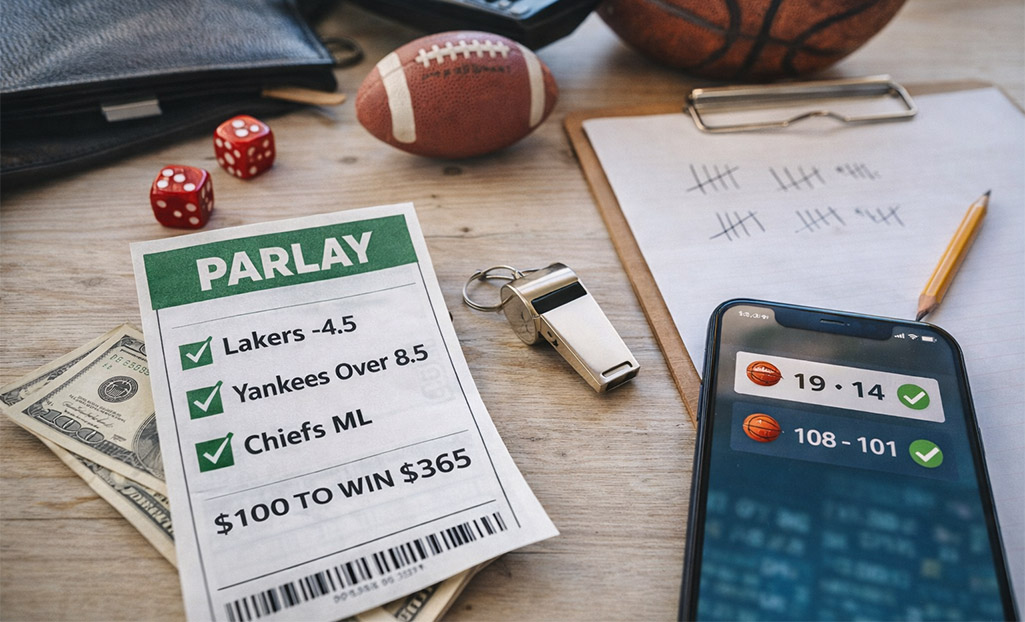
Example of a multi-leg parlay combining spread, total, and moneyline bets.
In sports betting, a parlay bet combines multiple wagers into one single bet slip. Each individual wager is called a "leg".
Example:
- Lakers -4.5 (-110)
- Chiefs Moneyline (-150)
- Yankees Over 8.5 (-105)
- If all three win → your parlay wins.
- If one loses → the whole bet loses.
There are no partial wins in a standard parlay.
Why Do Parlays Pay More?
Because you’re stacking probability. Instead of being paid separately for each bet, the sportsbook multiplies the odds together. The more legs you add:
- The bigger the payout
- The lower the chance of winning
How Parlay Payouts Are Calculated
Let’s slow this down and make it simple. We’ll use a basic 2-leg parlay example.
2-Leg Parlay
Example:
- Bet 1: -110
- Bet 2: -110
- Stake: $100
Step 1: Convert American Odds to Decimal Odds
American odds like -110 aren’t easy to multiply. But a parlay works by multiplying odds together. So first, we convert them into decimal format, which is simpler to calculate.
When you convert -110, you get:
-110 = 1.91
What does 1.91 actually mean?
It means:
For every $1 you bet, you get $1.91 back if you win.
That includes your original $1.
So if you bet $100 at 1.91 odds:
$100 × 1.91 = $191 total return
($91 profit + your $100 stake back)
Since both bets are -110, they both become:
1.91 and 1.91
Now we’re ready for the parlay calculation.
Step 2: Multiply the Odds Together
This is the key idea behind a parlay. When you win the first bet, your total return rolls into the second bet automatically.
It’s like this:
- You win the first bet.
- Instead of cashing out, you automatically reinvest everything into the second bet.
That’s why we multiply:
1.91 × 1.91 = 3.65
Now your combined odds are 3.65.
What does 3.65 mean?
It means:
For every $1 you bet, you get $3.65 back if both bets win.
Step 3: Multiply by Your Stake
Now we apply your actual bet amount.
You risked $100.
So we multiply:
Important:
That $365 includes your original $100.
So your actual profit is:
What If You Bet Them Separately?
If you placed $100 on each bet individually:
- First bet profit: $90.91
- Second bet profit: $90.91
- Total profit: $181.82
So yes — the parlay pays more. But if just one bet loses, you lose the full $100.
That’s the trade-off.
3-Leg Parlay
Example:
Three -110 bets
1.91 × 1.91 × 1.91 = 6.96 decimal odds
$100 returns $696
Profit = $596
Sounds amazing, right?
Now here’s the part most beginners don’t calculate…
The Real Math: Why Parlays Are Hard to Win
A typical -110 line implies about a 52.4% chance of winning.
How Is -110 Converted to Probability?
American odds don’t just show potential payout — they also reflect implied probability. And when you combine multiple legs in a parlay, those probabilities multiply — just like the odds do.
For negative odds like -110, the formula is:
Probability = Odds ÷ (Odds + 100)
So for -110:
110 ÷ (110 + 100) = 110 ÷ 210 = 52.4%
This means the sportsbook is pricing that outcome as having roughly a 52% chance of winning.
If each leg has a 52.4% probability:
0.524 × 0.524 × 0.524 = 14.4%
That means you’d win only about 1 out of 7 attempts on average.
Probability Drop Per Leg
If each leg has about a 52.4% chance of winning (-110 odds):
- 2 legs → 27.5%
- 3 legs → 14.4%
- 4 legs → 7.5%
- 5 legs → 3.9%
Each added leg cuts your true chance of winning almost in half. This is why 5- or 6-leg parlays are far harder to win than they appear at first glance.
Add more legs?
Your probability drops fast.
Types of Parlays Explained
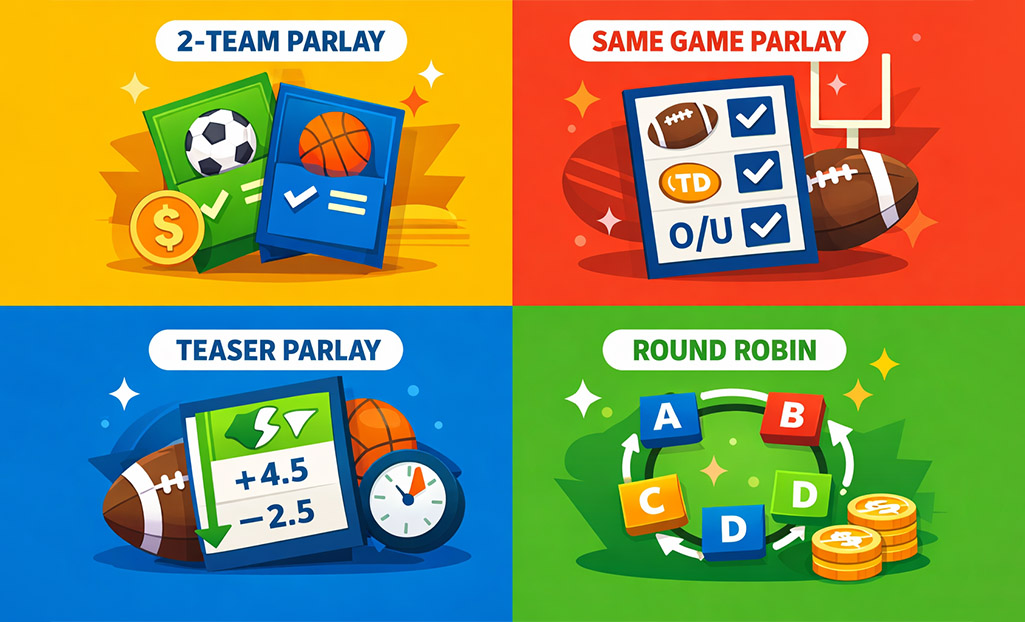
The main types of parlay bets explained: standard, same game, teaser, and round robin.
Not all parlays work exactly the same way. While the basic idea is always "multiple bets combined into one," there are different formats that change how risk and payouts behave. Let’s break them down in simple terms.
1. Standard Parlay
A standard parlay combines multiple unrelated bets into one ticket.
Example:
- Lakers -4.5
- Yankees Over 8.5
- Cowboys Moneyline
These bets come from different games and have nothing to do with each other.
To win:
All selections must win.
If one loses:
The entire bet loses.
2. Same Game Parlay (SGP)
A Same Game Parlay combines multiple bets from the same game.
Example:
Mahomes over 250 passing yards
Chiefs to win
Kelce anytime touchdown
All three bets depend on the same matchup.
Why?
Because you can create a "story" for how you think the game will play out.
For example:
"If Mahomes throws for 300 yards, the Chiefs probably win, and Kelce likely scores."
However, sportsbooks often build in extra margin on Same Game Parlays. So while they’re fun, they can be slightly less favorable long term.
3. Teaser (Football & Basketball)
A teaser is a special type of parlay where you adjust the point spread in your favor.
Example in football:
Original line: Chiefs -7
Teased line: Chiefs -1
You get 6 points of advantage. That makes it easier to win each leg.
But here’s the trade-off:
The payout is smaller than a normal parlay. So a teaser reduces risk slightly, but you’re still required to win all legs.
4. Round Robin
A round robin spreads your selections across multiple smaller parlays instead of one big all-or-nothing bet.
Let’s say you pick 3 teams:
- Team A
- Team B
- Team C
Instead of one 3-leg parlay, a round robin creates:
- A + B
- A + C
- B + C
Now you have multiple 2-leg parlays.
What changes?
- You don’t need all three to win to make money.
- If two teams win, one of your smaller parlays still cashes.
The downside?
- You’re placing multiple bets at once, so your total cost increases.
- Round robins reduce risk — but require a larger upfront stake.
What Happens If One Leg Pushes?
If one leg pushes (ties the line):
- That leg is removed
- The parlay recalculates with remaining legs
Example:
3-leg parlay → one push → becomes a 2-leg parlay.
Why Sportsbooks Promote Parlays So Aggressively
Because:
- They increase variance
- They create emotional engagement
- Casual bettors love big payouts
- The house edge is often higher
Are Parlays a Good Strategy?
Not usually for long-term profit.
Parlays may make sense when:
- You’re betting for entertainment
- You’re risking small amounts
- You understand variance
- You’ve identified genuine correlated value
But for bankroll growth and serious betting?
Most experienced bettors prefer single wagers.
Who Should Avoid Parlays?
Parlays are generally not ideal for:
- Conservative bettors who prefer steady returns
- Bankroll builders focused on long-term growth
- Professional or disciplined bettors prioritizing consistency
- Anyone uncomfortable with high variance
If your goal is stability rather than excitement, single bets are usually the smarter choice.
Common Beginner Mistakes With Parlays
- Adding too many legs
- Chasing huge payouts
- Confusing excitement with strategy
- Ignoring implied probability
- Betting parlays as a primary system
Quick Parlay Calculator Formula
To estimate payout manually:
- Convert each bet to decimal odds
- Multiply them together
- Multiply by your stake
Formula:
Stake × (Decimal1 × Decimal2 × Decimal3…)
Parlay vs Single Bet
| Feature | Single Bet | Parlay |
|---|---|---|
| Risk | Lower | Higher |
| Variance | Moderate | Very High |
| Bankroll Stability | Stronger | Volatile |
| Payout Potential | Moderate | High |
Singles = consistency
Parlays = volatility
Final Takeaway
A parlay is a high-risk, high-reward bet that combines multiple selections into one ticket. The payout increases because the odds multiply — but your chances of winning decrease with each added leg.
Smart betting starts with understanding probability, not chasing big numbers.