How to Check If a Betting Site Is Licensed and Regulated
To check if a betting site is licensed in the US, you need to verify its state regulator and confirm the operator on the official state gaming authority website.
A licensed and regulated betting site is approved by a state gaming authority and must follow strict rules to protect your money, personal data, and player rights. Unlicensed sites, on the other hand, can delay payouts or operate without legal oversight.
The good news? You can verify a sportsbook’s license in less than 5 minutes.
Here’s exactly how to do it.
Methods to Check If a Betting Site Is Licensed and Regulated
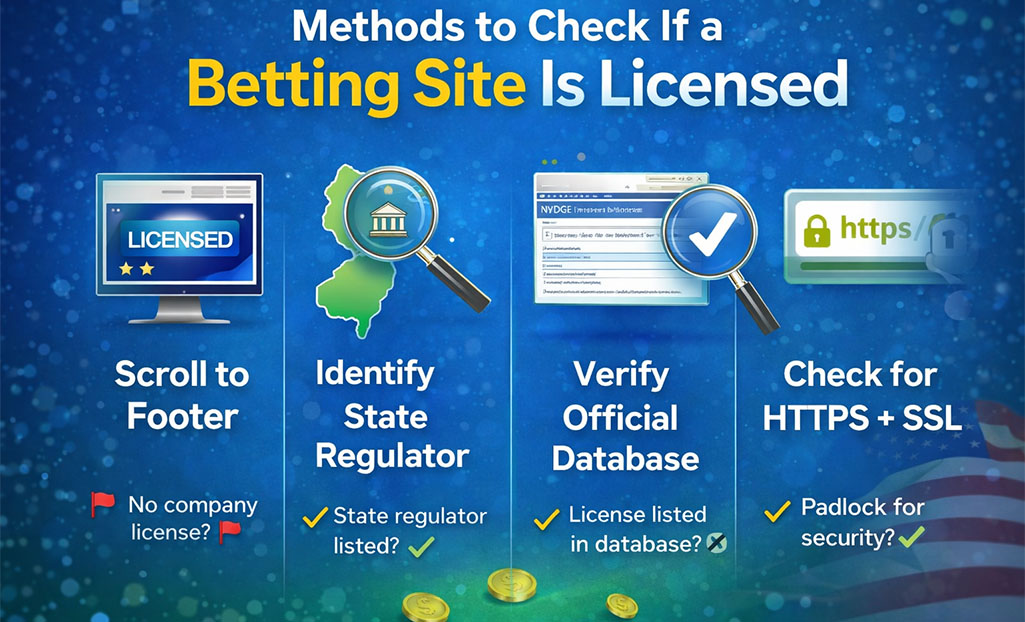
Visual guide outlining key steps to verify whether an online betting site is legally licensed and secure.
There are several simple ways to confirm whether a sportsbook is properly licensed and regulated in the US. Below, you’ll find practical methods you can use to verify its legality, security, and compliance before depositing any money.
Scroll to the Footer (Yes, Really)
Every legitimate betting site displays its licensing information at the bottom of its homepage. Scroll down and look for:
- The name of a regulatory authority
- A license number
- A state seal (New Jersey, Pennsylvania, Michigan, etc.)
- Responsible gambling logos
A legitimate regulator logo should be clickable and redirect you to the official regulator’s verification page.
If you don’t see licensing details anywhere, that’s your first red flag. No serious US sportsbook hides its license.
Identify the Regulator (It Must Match Your State)
In the United States, sports betting is regulated at the state level. That means a sportsbook must be licensed in the state where it operates.
Here are some of the main US regulators:
- New Jersey Division of Gaming Enforcement (NJDGE)
- Pennsylvania Gaming Control Board (PGCB)
- Michigan Gaming Control Board (MGCB)
- Nevada Gaming Control Board
- New York State Gaming Commission
Example:
✔️ In New Jersey, sportsbooks must be licensed by the NJDGE.
❌ A Curaçao license indicates an offshore operator, not a US-regulated one.
Verify the License on the Official Website
This is the step most people skip.
Don’t just trust the logo.
Instead:
1️⃣ Go to the official website of the regulator (for example, NJDGE).
2️⃣ Look for a section like:
- “Licensed Operators”
- “Approved Sportsbooks”
- “Gaming Licensees”
3️⃣ Search for the sportsbook’s name.
When the sportsbook appears on the official regulator’s list, you can be confident it’s properly licensed.
If it’s not listed there, the site is not legally authorized in that state. Simple as that.
Check for HTTPS Security
Licensing is one thing. Security is another.
Look at the address bar:
- Does it start with https:// ?
- Do you see the padlock icon?
Click the padlock to view the SSL certificate issuer and confirm the site’s identity. This allows you to verify that the encryption certificate matches the operator’s official domain.
That’s a dealbreaker.
Review the Responsible Gambling Section
Licensed sportsbooks are legally required to offer specific consumer protection tools designed to safeguard players and promote responsible gambling. For example:
- Deposit limits
- Self-exclusion tools
- Problem gambling resources
- Clear terms and conditions
The absence of a responsible gambling page is a strong sign the site isn’t properly regulated.
Quick 30-Second Safety Checklist
Before you deposit, run through this:
- License displayed in footer
- Regulator matches your state
- License verified on official regulator website
- HTTPS secure connection
- Clear terms & conditions
- Responsible gambling tools available
What About Offshore Betting Sites?
Some betting sites operate under offshore licenses (like Curaçao). While they may accept US players, they are NOT regulated by US state authorities.
That means:
- No US legal protection
- Limited dispute resolution
- Less oversight
- Harder to recover funds
Licensed US Sportsbooks vs Offshore Sites
If you're still unsure whether regulation really makes a difference, here’s a quick side-by-side comparison:
| Feature | US Licensed Sportsbook | Offshore Betting Site |
|---|---|---|
| State Regulation | Yes | No |
| Legal Protection | Full US Protection | Limited or none |
| Player Fund Protection | Required by law | Not guaranteed |
| Dispute Resolution | Formal legal process | Often unclear |
| Responsible Gambling Tools | Mandatory | Optional |
| Regulatory Audits | Regular state audits | Rare or none |
Why Licensing Actually Matters
A state-licensed US sportsbook is required to:
- Keep player funds separate from company funds
- Follow anti-money laundering rules
- Verify player identity
- Submit to audits
- Provide formal dispute resolution
Common Red Flags of Unlicensed Betting Sites

Advanced security features that protect players on regulated U.S. betting platforms.
Shady betting sites often reveal themselves through small warning signs. Catching these early can help you avoid unnecessary risk.
Watch out for:
- Unrealistic bonuses (“Guaranteed 100% wins”)
- No company address
- Broken English across the website
- No clear terms and conditions
- Only crypto deposits accepted
- No customer support phone or live chat
Conclusion
As you can see, checking whether a betting site is licensed isn’t complicated — but skipping this step can be costly.
Before depositing any money, take a moment to:
- Confirm the state regulator
- Verify the license independently
- Avoid offshore operators if you want full US legal protection
Smart bettors don’t just chase the best odds. They make sure the site is legal first.