How to Place Each‑Way Bets on Horse Racing and Football

Not sure how to place each-way bets?
An each-way bet is just two bets in one:
- One backs your selection to win
- The other covers it finishing in the places
On paper, it sounds simple, but the moment you look at odds, place terms and a bet slip, it’s not always obvious what’s happening.
Once you see how it’s split, though, everything feels much more natural — and placing the bet becomes a lot clearer.
What You’re Actually Placing
Before going further, it helps to be completely clear on what an each-way bet includes.
You’re placing:
- A win bet
- A place bet
Both are applied to the same selection.
So when you see something like:
- £5 each-way → total £10
- £10 each-way → total £20
That’s because you’re funding both sides of the bet.
The place part pays a reduced version of the odds, usually:
- 1/5 of the odds
- 1/4 of the odds
The bookmaker also sets how many finishing positions count as a "place", and this can change depending on the event.
Step 1: Choose the Right Market
The first step when learning how to place each-way bets in the UK is choosing a market where this type of bet actually makes sense.
You’ll mostly find it in:
- Horse racing
- Football outright markets
Horse racing is where each-way betting is most commonly used, especially in large races with many runners. Events like Cheltenham or Royal Ascot often include more places, which makes the each-way option more appealing.
In football, this type of bet is usually linked to longer-term markets such as:
- Top goalscorer
- Tournament winner
- Season awards
These markets allow multiple finishing positions, which is exactly what each-way betting relies on.
Step 2: Pick Your Selection and Read the Terms
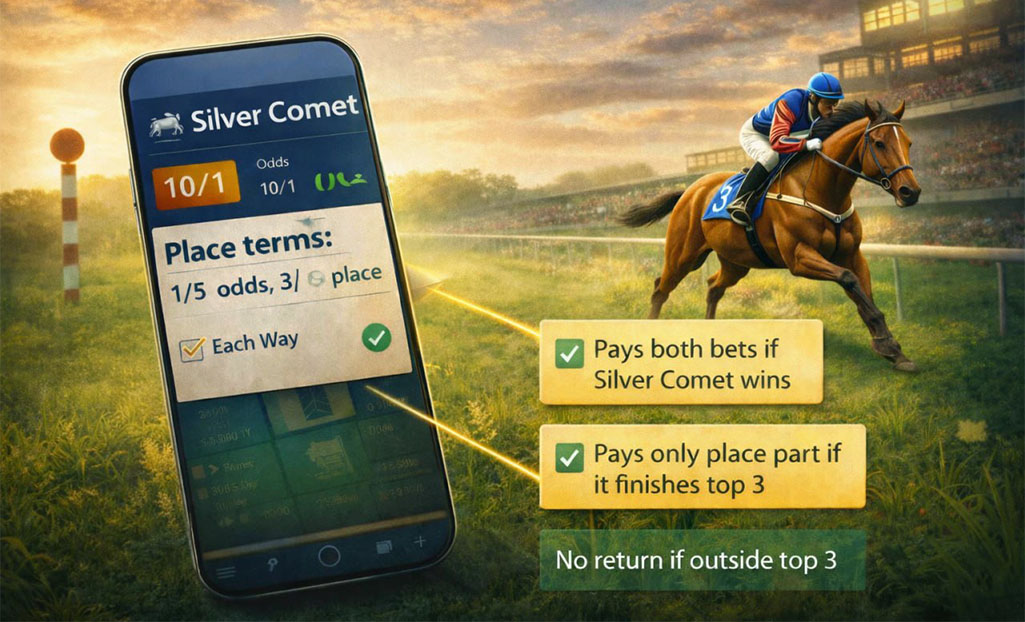
Example showing how each-way bets work in horse racing
After choosing the market, the next step is selecting what you want to back.
But instead of focusing only on the odds, it’s important to check the place terms, since they determine how the second part of your bet works.
Example from horse racing:
- Horse: Silver Comet
- Odds: 10/1
- Place terms: 1/5 odds, 3 places
This means:
- A win pays both parts of the bet
- A finish inside the top 3 pays only the place part
- Finishing outside those positions means the bet doesn’t return anything
That single line of place terms explains exactly how your bet behaves.
Step 3: Enter Your Stake
Now you move to the bet slip.
On most UK bookmakers, you’ll see an option to switch on Each-Way once your selection is added.
Here’s how it works in practice:
- Stake entered: £5
- Each-way selected: yes
This creates:
- £5 on the win
- £5 on the place
- Total stake: £10
Step 4: Check the Bet Slip Before Confirming
Before placing the bet, take a quick look at how everything is displayed.
You’ll usually see:
- The win stake
- The place stake
- The adjusted place odds
- Estimated returns
Example:
- Win: £5 at 10/1
- Place: £5 at 2/1
The place odds come from applying the fraction (1/5) to the original odds.
Once you see how it’s split, everything starts to make more sense and placing the bet feels much more straightforward.
Horse Racing Example: What Happens
Let’s walk through a full example so you can see the outcome clearly.
| Outcome | Win Part | Place Part | Result |
|---|---|---|---|
| Horse wins | Wins | Wins | Both parts paid |
| Horse finishes 2nd or 3rd | Loses | Wins | Partial return |
| Horse finishes outside | Loses | Loses | No return |
Example details:
- Stake: £10 each-way (£20 total)
- Odds: 10/1
- Place terms: 1/5 (→ 2/1)
- A win means both parts pay.
- A placed finish still returns something from the place side.
- Finishing outside the top positions results in a full loss.
That’s the balance each-way betting offers.
Football Example: How It Works There
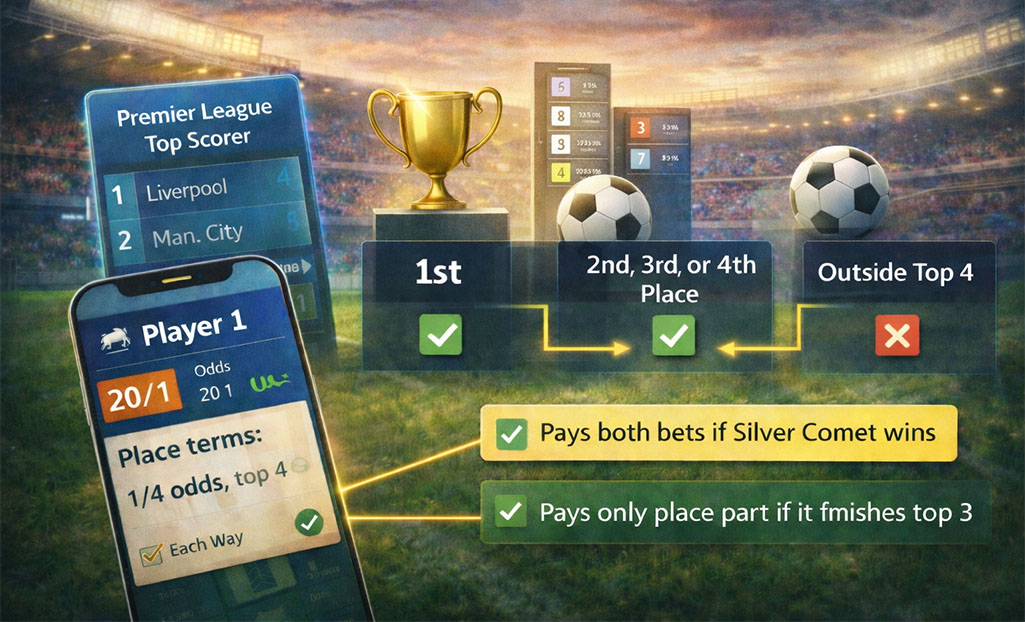
Example of each-way bets in football top scorer markets
The same idea applies in football, but usually in longer-term markets.
Example:
- Market: Premier League top scorer
- Odds: 20/1
- Place terms: 1/4 odds, top 4
Here’s how the outcomes look:
- Finishing 1st → both parts pay
- Finishing 2nd, 3rd or 4th → place part pays
- Outside top 4 → no return
This is where learning how to place each-way bets becomes useful, especially in competitive markets where finishing near the top is realistic even without winning.
When Each-Way Bets Make Sense
This type of bet tends to work well when:
- The odds are relatively high
- Multiple places are available
- The selection has a strong chance of finishing near the top
In these situations, the place part gives you a second route to a return.
When It Might Not Add Much Value
There are also cases where it doesn’t offer much advantage:
- Low odds selections
- Very limited place positions
- Low place payouts
In those situations, the place side may not justify the extra stake.
A Quick Way to Estimate the Return
You don’t need to calculate everything in detail every time. A quick way to get a rough idea is to focus on the place part of the bet.
Here’s a simple way to do it:
- Take the original odds
- Apply the place fraction
- Multiply that by your place stake
Example:
- 10/1 odds
- 1/5 place terms → becomes 2/1
- £5 place stake → £10 profit
You don’t need exact numbers to get the idea — this already shows what the place part could return and whether it feels worth it.
Conclusion
After you’ve placed a few bets like this, you start to see where how to place each-way bets actually makes a difference and where it doesn’t really add much.
You’re not overcomplicating anything, just working with two sides of the same idea:
- One going for the win
- One giving you something back when things go close
That’s why it shows up so often in horse racing and football markets across the UK — it gives you a bit more flexibility without changing the bet completely.