Live Betting 101: Timing and Line Movement Guide
Live betting (also called in-play betting) lets you place wagers while a game is happening in real time. Unlike pre-game bets, live odds constantly adjust based on the score, time remaining, injuries, momentum shifts, and betting market activity.
In this guide, you’ll learn:
- How live betting actually works behind the scenes
- Why odds change during games
- How to read line movement
- When to time your in-play bets
- Example of a real match and more
Let’s break it down in a practical way.
What Is Live Betting?
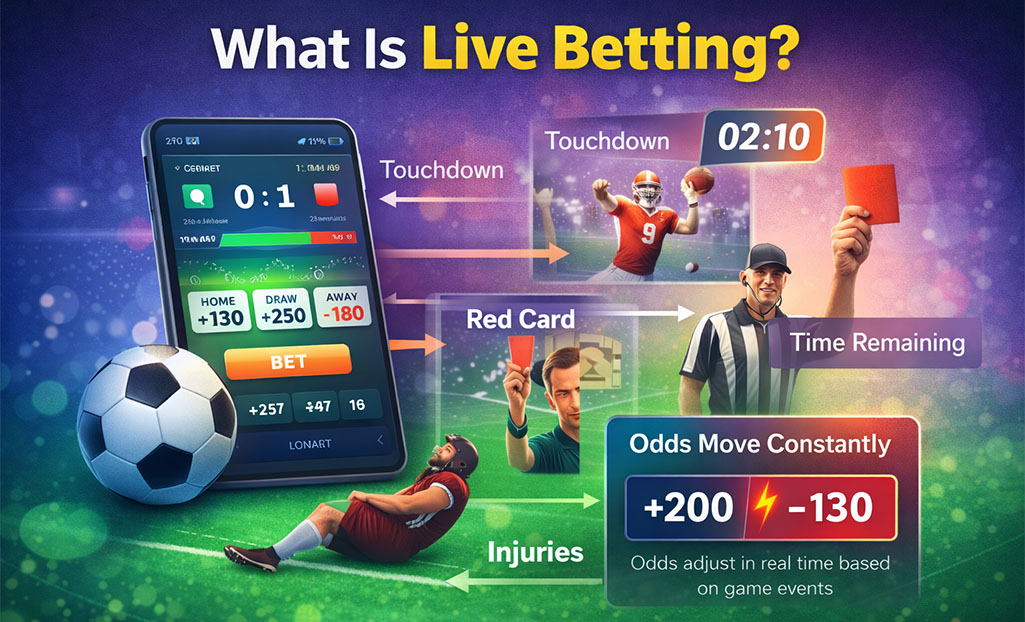
Example of how live betting works, showing real-time odds adjustments based on game events.
Live betting (also called in-play betting) allows you to place bets after a game has already started. Unlike pre-game betting, live odds change constantly based on what’s happening in real time.
Let’s look at a simple NBA example.
Before the game
Lakers -6 (Point Spread)
This means the Lakers are expected to win by 6 points.
If you bet on them, they must win by more than 6 for the bet to win.
Five minutes into the game
Score: Lakers 4 – Opponent 12
Now the live line shifts to:
Lakers -1.5
This means they now only need to win by 2 or more points.
Why Did the Line Move?
Because the sportsbook adjusted its expectations.
The Lakers falling behind early lowers their projected winning margin, so the spread becomes smaller.
Why Do Live Odds Change?
There are three main drivers behind line movement in live betting.
Game Events
Big moments trigger immediate shifts:
- Goals in soccer
- Touchdowns in football
- Red cards
- Injuries
- Fouls in basketball
A red card in soccer can completely flip a moneyline in seconds.
Time Remaining
Time is everything in live betting.
If a team is trailing by 7 points:
- With 40 minutes left → comeback probability is high
- With 2 minutes left → probability drops sharply
The less time remaining, the more dramatic the odds shifts.
Market Activity
Sportsbooks also adjust based on betting volume.
If a large amount of money comes in on one side, the line may move to balance risk. This is why sometimes you’ll see movement even without a major event.
Understanding Line Movement in Live Betting
Not all line movements are equal. Learning to spot the difference is crucial.
Sharp Reaction
This happens after a major event.
Example:
Underdog scores first in soccer → odds swing heavily.
These moves are usually justified.
Gradual Adjustment
Not every line movement happens because of a big play. Sometimes odds shift slowly and steadily as the clock runs down.
This happens because of probability decay — as time passes, the trailing team has fewer opportunities to score, which naturally lowers their chances of winning.
For example:
If a team is down by 7 points:
- With 30 minutes left, a comeback is realistic.
- With 2 minutes left, it becomes much less likely.
Even if nothing dramatic happens, the odds will gradually adjust to reflect the shrinking time available.
Overreaction (Where Opportunity May Exist)
Sometimes live markets adjust too aggressively after a single event.
Example:
Before the game, Team A is -200 on the moneyline (about a 67% implied chance of winning).
In minute 6, they concede a goal.
The live line flips to +140 (about a 42% implied chance).
That’s a massive drop in projected probability in just a few minutes.
But if the stats show:
- 75% possession
- 6 shots to 1
- No injuries or red cards
Then the early goal may not reflect the true balance of the game.
In situations like this, disciplined bettors ask:
Did the team really become much weaker — or did the market simply react too fast?
How to Time Your Live Bets Strategically
This is where many beginners slip up — they react to the moment instead of thinking it through.
Instead of betting on impulse, use a simple structure you can follow every time. For example:
Strategy 1: Let Early Volatility Settle
The first few minutes often create exaggerated swings.
Example in NFL:
Underdog scores opening touchdown → line flips dramatically.
Instead of chasing instantly, wait for:
- Drive stabilization
- Defensive adjustments
- More data
Early chaos often creates inflated prices.
Strategy 2: Look for Performance vs Score Mismatch
This is one of the strongest live betting concepts.
If the scoreboard doesn’t match performance metrics, there may be value.
Soccer example:
- Score: 0-1
- Shots: 9-2
- Expected goals (xG): 1.4 vs 0.3
- Possession: 68%
If the trailing team is dominating statistically, their odds may offer value.
Strategy 3: Understand Time Leverage
Live betting is about time-adjusted probability.
Ask yourself:
- Is there enough time left for the comeback?
- Does this team have scoring capability?
- Are they playing aggressively or sitting back?
A basketball game with 18 minutes left is very different from one with 2 minutes left.
Reading a Live Soccer Match
Let’s walk through a realistic scenario.
Before the Game
- Team A (home favorite): -150
- Team B: +350
- Draw: +260
Team A implied win probability ≈ 60%
Minute 12 – Goal for Team B
Score: 0-1
Live odds update:
- Team A: +130
- Team B: +180
- Draw: +220
Now Team A implied probability ≈ 43%
Step 1: Check the Context
- Is Team A still controlling possession?
- Any injuries?
- What are shot numbers?
- Was the goal from a counterattack or sustained pressure?
Step 2: Evaluate Time Remaining
78 minutes left is a lot in soccer.
The model penalizes them because they’re trailing, but mathematically they still have plenty of time.
Step 3: Compare Pre-Game Expectations
Ask:
Did the early goal fundamentally change team strength?
Or just the scoreboard?
Live Betting Checklist (Use This Before Every Bet)
Before placing a live wager, ask:
- Has true probability changed, or just the score?
- Is the line reacting emotionally?
- Is there enough time left?
- Are key players still on the field?
- Am I betting because of strategy or impulse?
If you can’t answer these calmly, don’t click.
Common Mistakes in Live Betting
Even if you understand how live odds move, mistakes usually happen in the heat of the moment.
❌ Chasing Losses
Live betting makes it easy to “get it back.” Dangerous mindset.
❌ Betting Every Momentum Swing
Momentum feels powerful but isn’t always predictive.
❌ Ignoring Bookmaker Margin
Live markets often have higher vig than pre-game lines.
❌ Betting Too Fast
Odds flash quickly, but discipline beats speed.
Is Live Betting Profitable?
Live betting is not inherently profitable or unprofitable.
Sportsbooks still hold an edge.
However, live markets can create short-term inefficiencies due to:
- Rapid price adjustments
- Emotional public betting
- Overreaction to early events
As you can see, live betting isn’t about chasing every moment or trying to predict the next play — it’s about staying patient, thinking clearly, and recognizing when the numbers don’t fully reflect what’s happening on the field.
- When you approach it the right way, your focus shifts to:
- Reading how the odds move
- Comparing price vs real probability
- Managing your timing instead of reacting emotionally
- Making controlled, structured decisions
That’s what separates impulsive bets from smart ones.
In the end, the advantage doesn’t come from moving faster than the market — it comes from understanding it better.
Responsible Gambling Reminder
Live betting moves fast, and it can lead to multiple quick decisions. Set clear limits, define your stake size before the game starts, and never bet money you can’t afford to lose. Betting should be entertainment — not a financial strategy.