Responsible Gambling Resources: Help, Tools & Support
There’s a moment that’s hard to admit, even to yourself. It’s not when you lose a bet — that happens. It’s when you start thinking about the next one before the current one even ends.
Or when you tell yourself, "just one more"… and it never really is.
This isn’t about judgment. It’s about staying in control.
Quick Help (Right Now)
If things feel overwhelming, you don’t have to figure it out alone.
- Call or text: 1-800-GAMBLER
- Live chat available (24/7, free & confidential)
You don’t need to hit a breaking point to reach out. Even a quick conversation can help you reset.
Where to Get Help for Gambling Problems
If you feel like things are starting to get out of control, these are the most reliable places to turn to in the U.S.:
You’re not expected to handle this on your own — real help is available.
- National Council on Problem Gambling (NCPG)
- Gamblers Anonymous (group meetings, very supportive)
- SAMHSA Helpline: 1-800-662-HELP
They offer:
- Free counseling
- Anonymous support
- Conversations with people who get it
No pressure, no labels — just help.
Responsible Gambling: What It Really Means
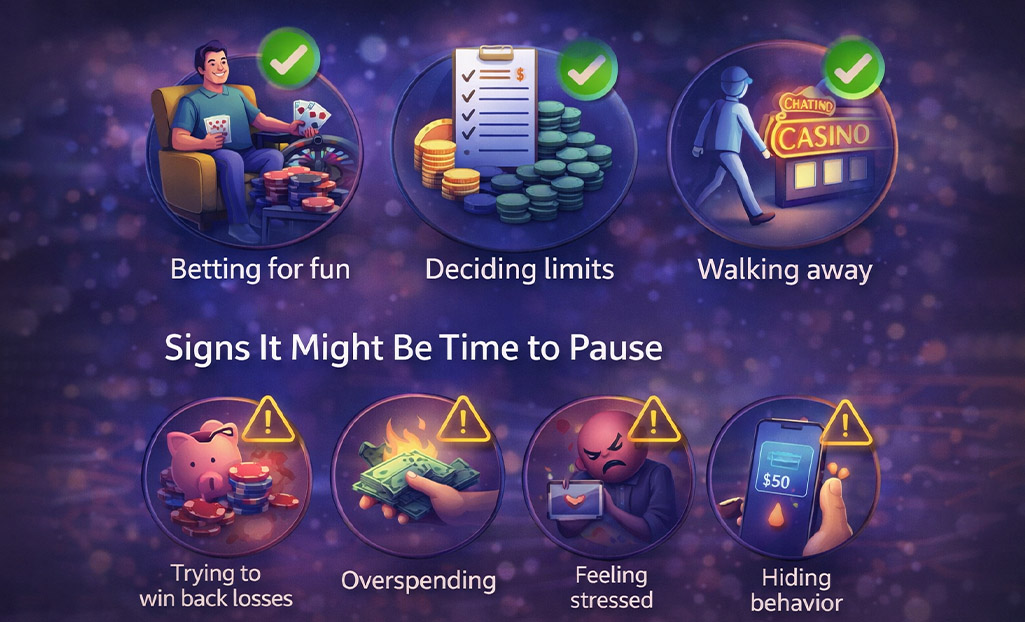
Know when to stop, set limits, and recognize risky behaviors
You’ll see this phrase everywhere, but let’s keep it real.
It simply means:
- You’re betting for fun, not pressure
- You decide your limits before you start
- You can walk away without feeling pulled back in
And when that balance shifts, even a little, it’s worth paying attention.
Signs It Might Be Time to Pause
- You’re trying to win back losses
- You’re spending more than you planned
- Betting is starting to feel stressful instead of fun
- You’re keeping it more private than you used to
You don’t need to check every box. Sometimes one is enough to take a step back.
Self-Exclusion: The "Hard Stop" Option
If you feel like willpower isn’t enough, this is one of the most effective tools out there.
Self-exclusion lets you block yourself from betting platforms on purpose.
How it works:
1️⃣ You sign up for a program
2️⃣ Your accounts get locked
3️⃣ You can’t place bets for a set period
That’s it. No loopholes, no "just this once."
Where to do it in the U.S.
- State programs (like New Jersey, Pennsylvania, Michigan)
- Sportsbook tools (DraftKings, FanDuel, etc.)
Practical Tools You Can Use Today
Small changes can make a bigger difference than you think. You don’t need a complete reset overnight.
Just a few practical adjustments can help you stay in control, avoid impulsive decisions, and make betting feel manageable again instead of overwhelming.
Set a Personal Budget
Think of betting like entertainment.
Example:
- Weekly income: $500
- Budget: $20–$25 max
Once it’s gone, it’s gone. No reloads.
Turn On Limits (Seriously)
Most apps let you:
- Cap deposits
- Set time reminders
- Take "cool-off" breaks
It takes 2 minutes to set up — and it removes a lot of impulsive decisions later.
Track What You’re Actually Doing
Not mentally. Write it down.
| Day | Bet | Amount | Result |
|---|---|---|---|
| Mon | NBA | $10 | Loss |
You’ll quickly notice patterns you don’t see in the moment.
What Actually Works
People tend to think they just need more discipline. In reality, what helps most is structure.
Things that make a real difference:
- Talking to someone early
- Blocking access completely (not partially)
- Creating distance from apps and triggers
- Replacing the habit with something else
What usually doesn’t work:
- Trying to "win it back"
- Lowering bet sizes but continuing
- Ignoring the feeling that something’s off
Quick Self-Check (Be Honest Here)
Ask yourself:
- Do I ever bet more than I planned?
- Do I feel the urge to recover losses?
- Do I feel uneasy about my betting sometimes?
If you answered "yes" to more than one, that’s not a failure — it’s just a signal.
And signals are meant to be acted on.
Conclusion
As you can see, this isn’t about quitting or judging yourself.
It’s about staying in control of something that’s meant to be entertainment.
You’ve got more control than you think.