U.S. vs. International Gambling Laws: Key Differences

Are gambling laws the same everywhere? Not even close.
Depending on where you are, something as simple as placing a bet can be completely legal… or not. And that’s where things start to get interesting.
In this guide, I’ll walk you through the real differences in U.S. vs. International Gambling Laws—and what they actually mean before placing a bet.
Quick Comparison
| Feature | United States | International Markets |
|---|---|---|
| Regulation | State-by-state | National (usually) |
| Online Betting | Limited | Widely available |
| Licensing | State licenses | National regulators |
| Taxes | Often required | Sometimes tax-free |
| Simplicity | Complex | More straightforward |
How Gambling Laws Work in the U.S.
Here’s where things get a bit complicated.
That means:
- Some states allow online sports betting
- Others only allow in-person betting
- And some don’t allow it at all
Example:
- New Jersey → Fully legal online betting and casinos
- Texas → Mostly restricted
- Nevada → Legal, but online access is more limited than expected
In practice, crossing a state line can completely change what’s allowed.
Quick Tip:
Before signing up on any sportsbook, it’s always worth checking:
- Whether betting is legal in your state
- Whether the platform is licensed locally
That alone can save a lot of confusion later.
How International Gambling Laws Work
Now let’s look at how things work outside the U.S.
In many countries, gambling is regulated at a national level. That means one authority sets the rules for the entire country.
Examples:
- UK → Regulated by the UK Gambling Commission
- Spain → National licensing system
- Canada → Provincial system, but still more structured overall
The result is usually simpler:
- Same rules across the country
- Clear licensing systems
- Easier to understand what’s allowed
Now that we’ve looked at both systems, here’s where the difference becomes clearer:
Legal Frameworks and Jurisdiction Explained
One of the biggest differences in U.S. vs. International Gambling Laws comes down to how jurisdiction and legal authority are structured.
In the U.S., each state acts as its own legal authority, meaning operators must comply with different rules depending on the state.
In international markets, a single national regulator typically sets the legal framework, creating a more unified system for both operators and users.
Key Differences That Actually Matter

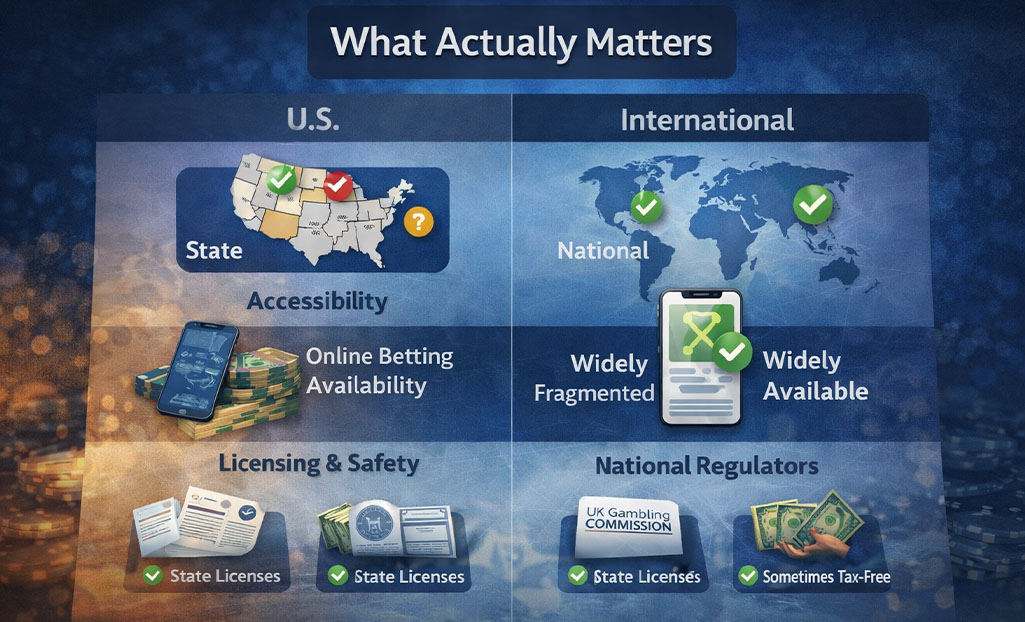
Key differences between U.S. and international online betting markets
Let’s break this down in a simple, practical way so you can clearly see what actually changes depending on where you are.
Accessibility
As mentioned earlier, in the U.S., whether you can bet or not depends largely on the state you’re in. Some states allow it, others limit it, and a few don’t allow it at all.
In many other countries, betting is regulated at a national level, so access tends to be the same no matter where you are.
Online Betting Availability
- U.S. → Fragmented and location-dependent
- International → More widely accessible
In many regions, getting started is as simple as registering on a licensed platform.
Licensing and Safety
This is one of the most important differences.
- U.S. → Strong regulation, but varies by state
- International → Often centralized and easier to verify
Recognized regulators like:
- UK Gambling Commission
- Malta Gaming Authority
…tend to signal a more structured and controlled environment.
Taxes
This is often overlooked.
In the U.S., gambling winnings are generally considered taxable income.
In many other countries:
- Taxes may not apply to individual players
- Or the system is simpler
This can directly affect how much you actually keep.
Common Pitfalls
There are a few things that tend to cause confusion.
Assuming availability means legality
Just because a platform is accessible doesn’t always mean it’s allowed where you are.
Overlooking tax obligations
It’s easy to focus on winnings and forget about reporting requirements.
Treating all regulated markets as equal
Not all systems offer the same level of oversight or protection.
Real-World Example
Let’s put this into perspective:
Someone in New Jersey
- Can legally place bets online
- Uses state-licensed platforms
- May need to report winnings
Someone in Spain
- Also has access to online betting
- Uses nationally licensed platforms
- Typically deals with a different tax structure
Same activity, different rules depending on location.
Conclusion
As you can see, the rules around betting aren’t the same everywhere—and that’s exactly why it pays to know where you stand before getting started.
Taking a minute to understand the landscape can help you move with more confidence and avoid unnecessary surprises along the way.