Gambling Act 2005: Understanding the UK’s Betting Framework

This law is the backbone of all legal betting in the UK. It defines who can offer gambling, how players are protected, and what rights bettors actually have when using licensed platforms.
In this guide, you won’t just learn what the Gambling Act 2005 is. You’ll understand how it affects real bettors, how to use it to stay protected, and why the UK is considered one of the safest betting markets in the world.
What Is the Gambling Act 2005 and Why Does It Matter?
In simple terms, the Gambling Act 2005 is the main law that regulates almost all forms of gambling in Great Britain (England, Scotland, and Wales).
It was introduced to modernize outdated gambling laws that no longer covered:
- Online betting
- Mobile betting apps
- Digital casinos
- Remote gambling platforms
Under this law: The gambling is legal, but only when offered by licensed and regulated operators
What Types of Gambling Are Regulated?

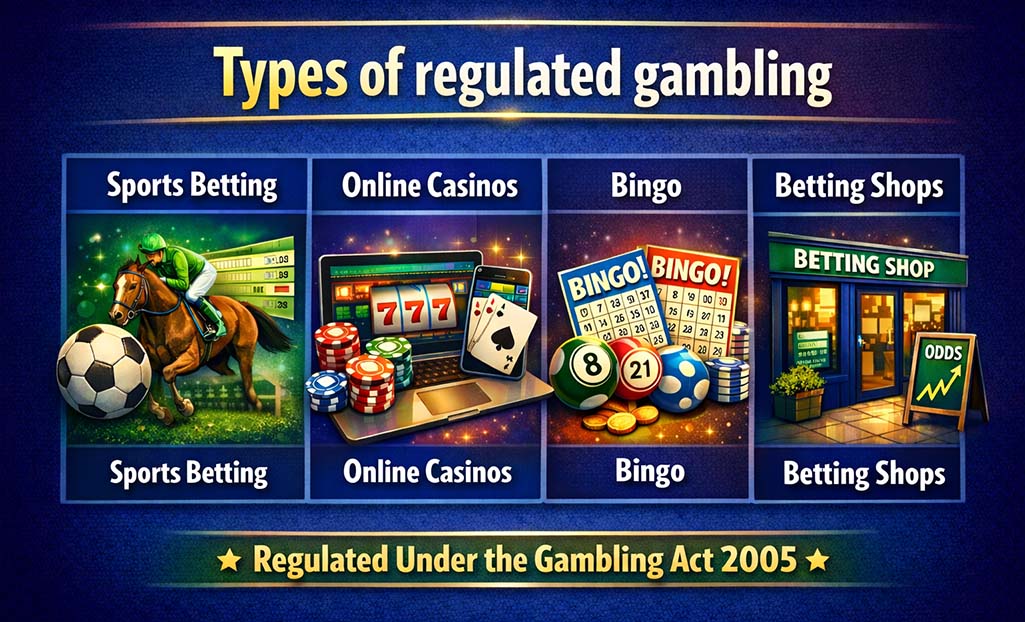
Main types of gambling activities regulated under the Gambling Act 2005 in the UK.
The Gambling Act 2005 applies to almost every form of gambling available to UK players. Whether you bet online, in a shop, or through an app, the activity is very likely regulated under this law.
To make this clearer, the table below shows which gambling activities are covered by current UK gambling law and which are regulated separately.
Gambling Activities Regulated Under the Gambling Act 2005
| Gambling Activity | Covered by the Gambling Act 2005 | Example |
|---|---|---|
| Sports betting | ✅ Yes | Football, tennis, horse racing |
| Online betting | ✅ Yes | Betting websites and mobile apps |
| Online casinos | ✅ Yes | Slots, blackjack, roulette |
| Land-based casinos | ✅ Yes | Physical casinos in the UK |
| Bingo (online & retail) | ✅ Yes | Bingo halls and online bingo |
| Gaming machines | ✅ Yes | Slot machines, fruit machines |
| Betting shops | ✅ Yes | High-street bookmakers |
| UK National Lottery | ❌ No | Regulated under separate law |
| Spread betting | ❌ No | Regulated as a financial product |
Why Was the Gambling Act 2005 Introduced?
The law is built around three core principles, officially known as licensing objectives. These objectives guide every regulatory decision related to gambling in the UK.
1. Prevent Crime and Illegal Activity
One of the main goals of the Gambling Act 2005 is to prevent gambling from being linked to crime. This includes stopping:
- Money laundering
- Fraud
- Match-fixing
- Illegal betting operations
2. Ensure Gambling Is Fair and Open
The law also ensures that gambling is conducted in a fair and transparent way. This means:
- Odds must be clearly displayed
- Games must not be manipulated
- Rules and terms must be understandable
For bettors, this creates trust. You should always know what you’re betting on and how outcomes are determined.
3. Protect Children and Vulnerable Players
This is one of the strictest parts of UK gambling law. The Gambling Act 2005 strictly prohibits:
- Underage gambling
- Advertising aimed at minors
- Misleading or exploitative practices
Licensed operators must offer:
- Deposit limits
- Loss limits
- Time-outs
- Self-exclusion programs
The UK Gambling Commission: Who Regulates Betting?
One of the most important outcomes of the Gambling Act 2005 was the creation of the UK Gambling Commission (UKGC).
What Does the UK Gambling Commission Do?
For bettors, the UKGC:
- Issues licenses to operators
- Monitors betting companies
- Enforces responsible gambling rules
- Investigates complaints
- Fines or bans operators that break the law
How the Gambling Act 2005 Affects a UK Bettor
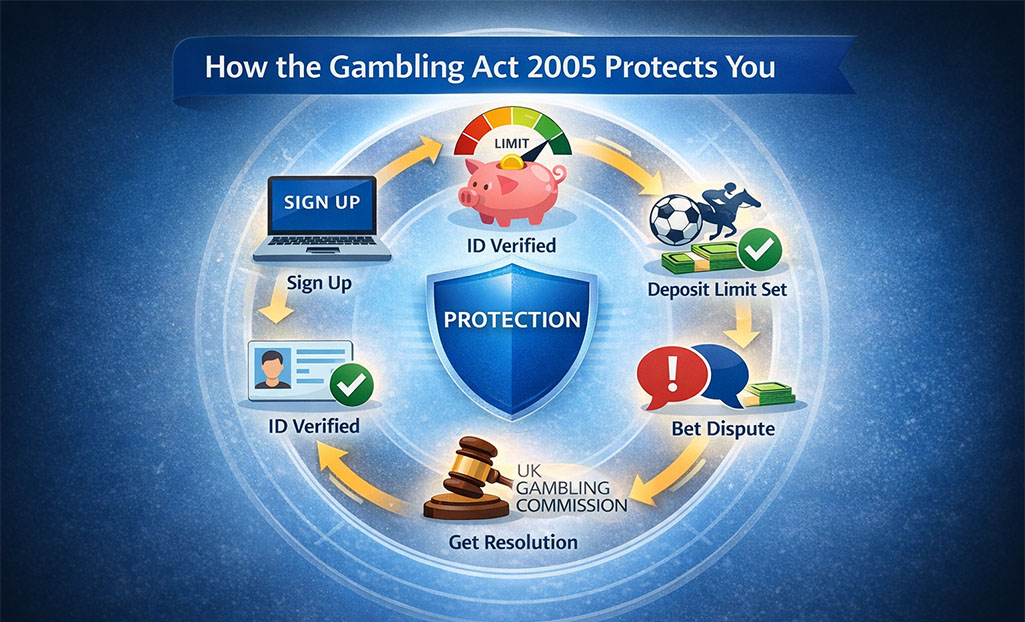
Example of how UK gambling law protects bettors throughout the betting process.
Let’s look at a real-world scenario.
Example:
-
You sign up to a UK betting site.
-
The site asks for ID verification.
-
You set a deposit limit.
-
You place bets legally.
-
A dispute arises over a settled bet.
Because the site is UKGC-licensed:
- Your identity is protected.
- The operator must follow clear rules.
- You can escalate disputes to an independent body.
- The UK Gambling Commission oversees the process.
What Does the Gambling Act 2005 Mean for Bettors?
-
Legal and Safe Betting
You can legally bet in the UK using licensed platforms.
-
Mandatory Player Protection
Licensed operators must provide:
- Age verification
- Responsible gambling tools
- Clear bonus terms
-
Dispute Resolution
Bettors have access to:
- Formal complaints
- Independent dispute resolution
- Regulatory oversight
How to Check If a Betting Site Is Legal in the UK
Before placing any bets, always make sure the site is properly licensed.
Step-by-step checklist:
- Scroll to the footer of the betting site
- Look for UK Gambling Commission licensing information
- Find the license number
- Verify it on the UK Gambling Commission public register
UK vs Unregulated Betting Markets
| Feature | UK-Regulated Betting | Unregulated Markets |
|---|---|---|
| Licensing | Mandatory | Often none |
| Player protection | High | Low |
| Responsible gambling tools | Required | Rare |
| Dispute resolution | Available | Limited or none |
| Legal protection | Strong | Weak |
Why the Gambling Act 2005 Still Matters Today
Even with:
- Mobile betting
- Live betting
- AI-powered platforms
The Gambling Act 2005 remains the foundation of UK gambling regulation.
It ensures:
- Legal but controlled gambling
- Operator accountability
- Strong player protection