Bankroll Management Strategies for Sports Betting


Bankroll management strategies are essential if you’re getting into sports betting and don’t want to lose your money faster than you expect. You don’t need to be an expert to bet smarter, but you do need to know how to divide your bankroll, control risk, and choose the right bet size so a bad streak doesn’t wipe you out.
In this guide, I’ll walk you through how bankroll management works in real life: how betting units actually help, why risk tolerance matters, and how advanced approaches like the Kelly Criterion are used. Everything is explained step by step, with clear examples you can apply right away.
Quick Summary
- Safe bet size: 1–2% per bet
- Best strategy for beginners: Fixed betting units
- Advanced option:Fractional Kelly
- High risk: Full Kelly (not recommended for beginners)
What Is Bankroll Management?
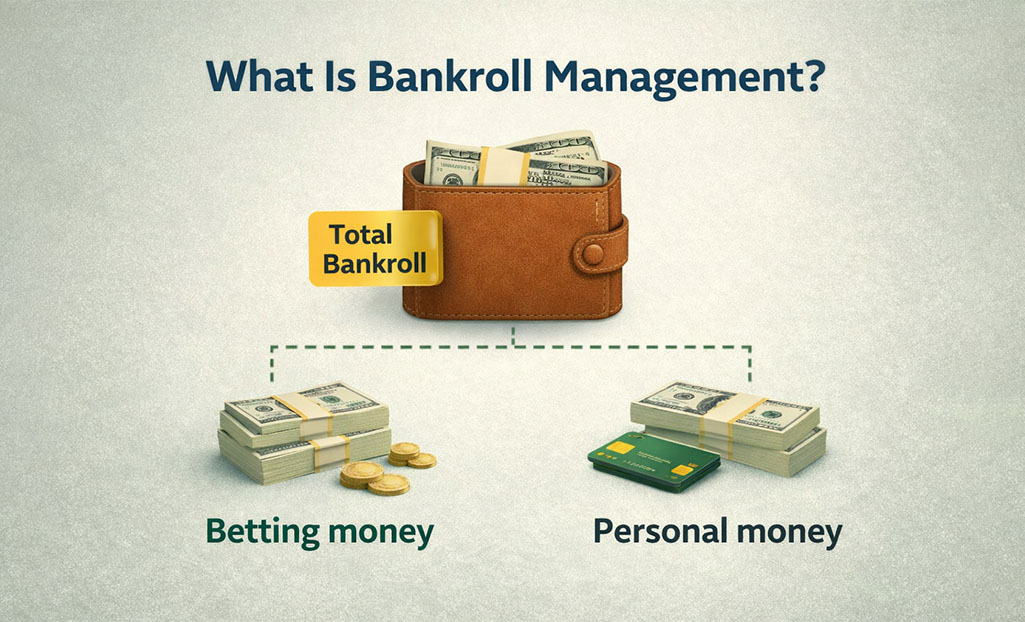

In sports betting, your bankroll is the total amount of money you have set aside exclusively for betting. This money should be completely separate from your personal finances and treated as money you can afford to lose.
Bankroll management strategies are the rules you follow to decide:
- How much to bet on each wager
- How to control losses during bad streaks
- How to protect your bankroll over time
Why Bankroll Management Strategies Matter
All bettors experience losing streaks. Even profitable bettors lose regularly. Without proper bankroll management:
- Losses feel overwhelming
- Bettors chase losses emotionally
- A few bad bets can wipe out the entire bankroll
With solid bankroll management strategies:
- Losses are controlled
- Risk remains consistent
- Decisions stay rational
- Long-term results improve
Betting Units Explained
One of the most important bankroll management strategies is using betting units instead of random bet amounts.
What Is a Betting Unit?
A betting unit is a fixed percentage of your bankroll. For most bettors, especially beginners, the recommended range is 1% to 2% per bet.
How to Divide Your Bankroll Using Units

Example of bankroll management using units: a $500 bankroll, 1% unit size, and a $10 maximum bet.
Let’s walk through a complete example from scratch.
Step 1: Define Your Total Bankroll
Assume your betting bankroll is:
- Total bankroll: $500
This is the maximum amount you are willing to risk.
Step 2: Choose Your Unit Size
For beginners, the safest bankroll management strategy is 1% per unit.
- 1% of $500 = $5 per unit
This means:
- 1 unit = $5
- 2 units = $10 (maximum recommended per bet)
Step 3: Apply the 1–2% Rule
To reduce risk:
- Standard bets: 1 unit ($5)
- High-confidence bets: 2 units ($10)
- Never exceed 2% of your bankroll on a single wager
This approach protects your bankroll during losing streaks and keeps risk under control.
How Risk Tolerance Affects Bankroll Management
Risk tolerance refers to how much volatility you can handle emotionally and financially. Different bettors have different comfort levels, but beginners should always start conservatively.
Common Risk Tolerance Levels
| Risk Level | Unit Size | Suitable For |
|---|---|---|
| Low Risk | 1% | Beginners |
| Medium Risk | 1.5–2% | Experienced bettors |
| High Risk | 3%+ | Not recommended |
The Kelly Criterion Explained
The Kelly Criterion is a mathematical bankroll management strategy that calculates optimal bet size based on odds and estimated probability.
Its purpose is to:
- Maximize long-term bankroll growth
- Reduce the risk of total loss
- Adjust bet size based on perceived edge
Where Do the Kelly Criterion Values Come From?

This diagram explains how the Kelly Criterion uses odds and probability to calculate the optimal percentage of bankroll to bet.
Some numbers are provided by the sportsbook, while others come from your own analysis. This distinction matters because the Kelly Criterion only works correctly when the inputs are realistic.
Kelly Criterion Formula
Where:
- f = fraction of bankroll to bet
- b = decimal odds − 1
- p = probability of winning
- q = probability of losing (1 − p)
b: Decimal Odds (Provided by the Sportsbook)
The value b comes directly from the odds offered by the sportsbook. If the sportsbook offers decimal odds, you calculate b by subtracting 1.
Example:
- Decimal odds: 2.00
- b = 2.00 − 1 = 1
This value is objective and does not require estimation.
p: Estimated Probability of Winning (Your Own Analysis)
The value p is not provided by the sportsbook. It represents your own estimate of how likely the bet is to win.
This is the most difficult part of the Kelly Criterion and also the most important.
Common beginner mistake
Many beginners assume:
This only gives the bookmaker’s implied probability and does not create an edge. Using this value makes Kelly ineffective.
How beginners can estimate p realistically
For beginners, probability estimation doesn’t need to be perfect, but it should be reasoned:
- Based on basic stats and recent performance
- Comparing your analysis to the odds offered
- Asking: “Out of 100 similar situations, how often do I expect this bet to win?”
Example:
- You believe the bet would win 55 times out of 100
- Estimated probability:
p = 0.55
q: Probability of Losing (Calculated Automatically)
The value q is simply the probability that the bet loses. Once you have p, you calculate q as:
- p = 0.55
- q = 0.45
No estimation is required here.
f: Fraction of the Bankroll to Bet (Final Result)
The value f is the result of the Kelly calculation. It represents the percentage of your bankroll the formula suggests betting.
You do not choose f manually — it comes from the formula.
Kelly Criterion Example (Step by Step)
Let’s put everything together.
Given:
- Decimal odds: 2.00
- Estimated probability of winning: 55%
Step 1: Calculate each value
- b = 2.00 − 1 = 1
- p = 0.55
- q = 1 − 0.55 = 0.45
Step 2: Apply the formula
What the Result Means
According to the Kelly Criterion, the suggested bet size is:
10% of your total bankroll
This does not mean the bet is safe. It only means that, if your probability estimate is accurate, this bet size maximizes long-term growth.
Important Warning for Beginners
The Kelly Criterion is powerful, but it assumes your probability estimate is correct. If your estimate is wrong:
- Bet sizes can become too large
- Risk increases instead of decreases
- Losses can escalate quickly
For this reason, most beginners are better off using:
- Fixed units (1–2%)
- Fractional Kelly (Half or Quarter Kelly)
Editorial note (important for trust)
If you don’t have a reliable way to estimate probabilities, using fixed betting units is usually safer than using the full Kelly Criterion.
Why Full Kelly Is Not Recommended for Beginners
While mathematically sound, full Kelly assumes perfect probability estimation, which is unrealistic for most bettors.
Risks include:
- Overestimating your edge
- Excessively large bet sizes
- High volatility
- Severe drawdowns
Fractional Kelly: A Safer Alternative
To reduce risk, many bettors use fractional Kelly, such as:
- Half Kelly (50%)
- Quarter Kelly (25%)
Using the example above:
- Full Kelly: 10%
- Half Kelly: 5%
- Quarter Kelly: 2.5%
Fractional Kelly limits volatility while still applying the core logic of the strategy.
Common Bankroll Management Mistakes
Avoid these mistakes if you want to bet responsibly:
- Chasing losses after losing bets
- Increasing bet size emotionally
- Betting inconsistent amounts
- Mixing bankroll with personal finances
- Ignoring long-term strategy
Practical Bankroll Management Rules
Follow these simple rules consistently:
- Define your bankroll clearly
- Use fixed betting units
- Never risk more than 1–2% per bet
- Track all your wagers
- Accept losing streaks as normal
- Focus on long-term performance
Final Thoughts
Bankroll management strategies are not about winning every bet. They are about protecting your money, managing risk, and staying disciplined.