Long-Term Betting Mindset: Win With Discipline


One day you’re winning, the next you’re questioning everything. That’s how betting usually feels at the beginning — unpredictable, a bit chaotic, and honestly… frustrating at times.
Then something clicks.
That’s where a long-term betting mindset changes everything.
Instead of chasing quick wins, you start focusing on decisions, consistency, and discipline. And that’s when things begin to make sense.
Why Short-Term Results Can Trick You
Here’s something most people don’t realize right away:
- You can make a great bet… and still lose.
- You can make a terrible bet… and still win.
That’s just how betting works.
It’s called variance, and it’s the reason why short-term results are unreliable.
The key is understanding that results don’t always reflect the quality of your decisions — at least not immediately.
Start Thinking Like a Business
One of the biggest mindset shifts is treating betting less like entertainment… and more like a system.
Think about how a business operates:
- It follows a process
- It tracks performance
- It doesn’t panic after a bad day
You can apply the same idea here.
Instead of asking:
"Did I win this bet?"
Try asking:
"Was this a smart decision based on my process?"
Build a Simple, Repeatable Process

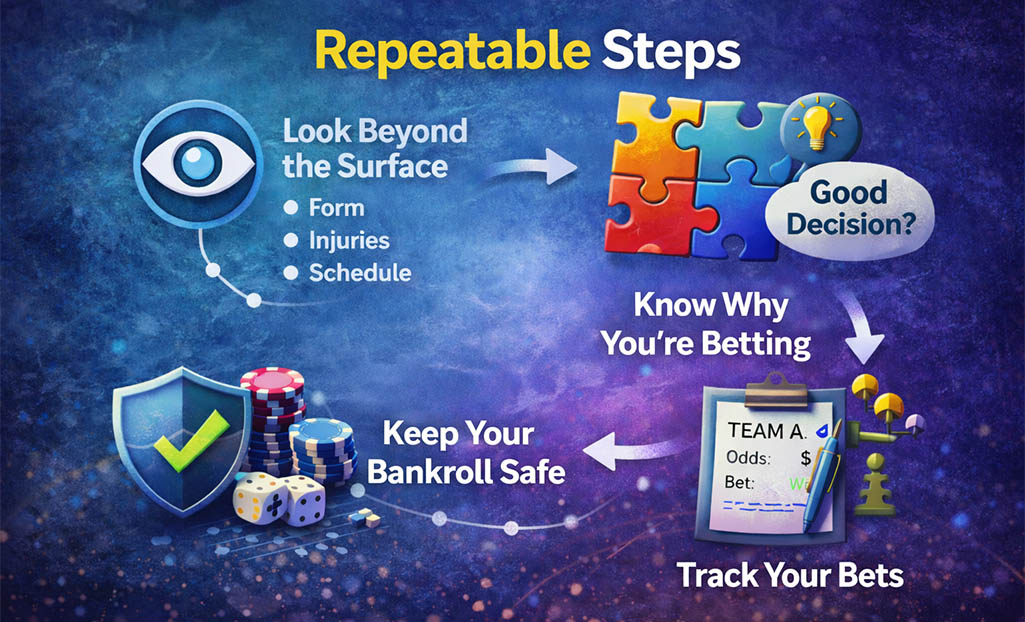
A simple framework to develop a long-term betting mindset and make more consistent decisions
You don’t need anything complicated. What matters is having a structure you can follow every time.
Here’s a practical way to approach it:
1. Look Beyond the Surface
Before placing a bet, take a minute to actually understand what’s going on:
- Recent performance
- Injuries or lineup changes
- Schedule and fatigue
- Motivation or context
This alone puts you ahead of most casual decisions.
2. Know Why You’re Betting
If you can’t clearly explain why a bet makes sense, it’s probably not worth taking.
A good habit is to think:
"What makes this a good decision in the long run?"
This keeps you grounded and prevents impulsive picks.
3. Keep Your Bankroll Safe
This is where discipline really shows.
This helps you survive losing streaks and stay in control.
4. Track Your Bets (Seriously)
This might sound boring, but it’s one of the most powerful things you can do.
Write down:
- What you bet
- Why you bet it
- The odds
- The result
Discipline Is What Makes the Difference
It’s easy to think success comes from being "good at picking winners."
But in reality, it comes from:
- Staying consistent
- Managing emotions
- Following your own rules
You’ve probably seen it (or experienced it):
- Increasing stakes after a loss
- Betting just to recover quickly
- Making random bets out of boredom
- A long-term mindset helps you avoid all of that.
Accept That Losing Is Part of the Process
No one likes losing. But it’s part of the game — even with a solid approach.
You can be doing everything right and still go through a rough stretch.
That doesn’t mean your system is broken.
What matters is:
- Are your decisions consistent?
- Are you sticking to your plan?
Focus on Getting Better, Not Just Winning
Instead of obsessing over profit, shift your focus to improvement.
After each session, take a minute to reflect:
- Did I follow my process?
- Did I make any emotional decisions?
- What would I do differently next time?
This turns betting into something much more valuable: a skill you develop over time.
Conclusion
Betting becomes much clearer when you stop thinking in terms of single outcomes.
It’s not about today’s win or loss.
That’s what a long-term betting mindset really means.
And once you adopt it, everything starts to feel a lot more controlled — and a lot less random.