How to Bet on Horse Racing in the UK: Odd, Bet Types & More

Horse racing betting in the UK looks simple… until someone starts talking about each-way bets, fractional odds or Cheltenham accumulators.
So if you’ve ever wondered how horse racing betting actually works in the UK, we’ll explain the odds formats, bet types, payouts and strategies you’ll come across before placing a bet.
Why Horse Racing Betting Is So Popular in the UK
Horse racing has been linked to betting culture in the UK for generations. Events like Cheltenham Festival, Royal Ascot and the Grand National attract millions of viewers every year, and a huge part of that popularity comes from the betting side of the sport.
That’s also why UK bookmakers are so closely connected to horse racing. Many betting formats that are now common worldwide — especially fractional odds and each-way betting — became popular through British horse racing first.
How Horse Racing Odds Work
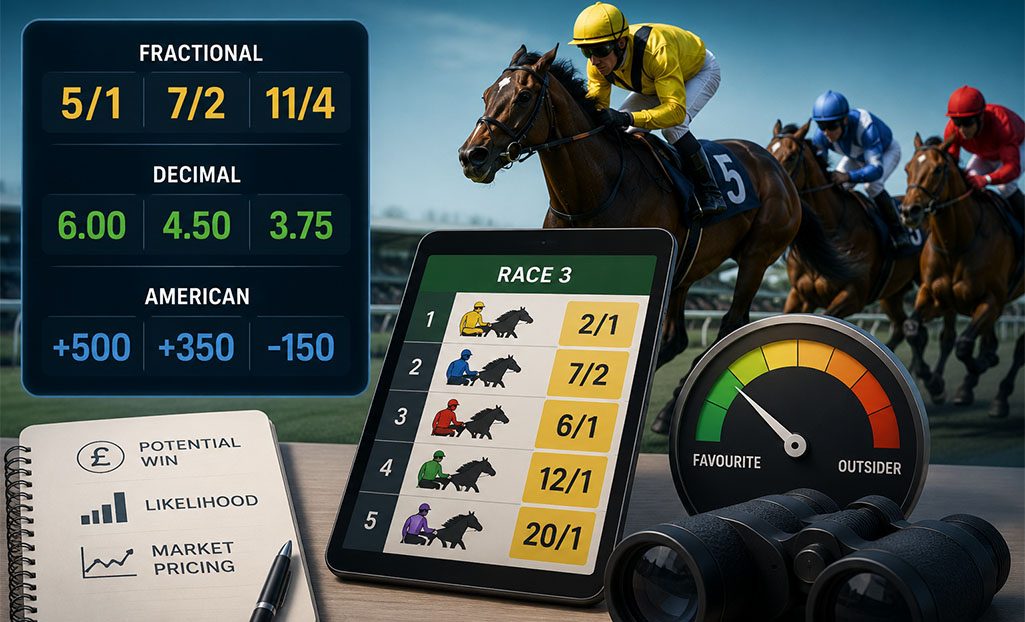
Visual comparison of the main horse racing odds formats used in UK betting
Before placing any bet, it’s important to understand what the odds are actually telling you.
Horse racing odds represent:
- How much you can win
- How likely a horse is expected to win
- And how bookmakers price the race market
For example:
- 2/1 odds suggest a stronger favourite
- 12/1 odds suggest an outsider with a lower chance of winning
In UK horse racing, you’ll mainly see three odds formats.
Fractional Odds
Fractional odds are the traditional UK format used in horse racing.
You’ll normally see odds written like:
- 5/1
- 7/2
- 11/4
The first number shows how much profit you win relative to your stake.
Example
If you place:
- £10 on a horse at 5/1
You would win:
- £50 profit
- Plus your original £10 stake back
Total Return:
£60
Decimal Odds
Decimal odds are easier to calculate because they already include your stake in the final number.
For example:
- 5/1 fractional odds
Becomes:
- 6.00 decimal odds
Example
£10 bet at 6.00 odds:
- £60 total return
- £50 profit
A lot of bettors prefer decimal odds because they’re quicker to understand at a glance.
American Odds
American odds are less common in UK horse racing, but some betting sites still offer them.
Positive odds show how much profit you make from a £100 stake.
Example:
+500 odds means:
- £500 profit from a £100 bet
Negative odds usually appear on favourites and work differently.
Odds Comparison Table
| Fractional | Decimal | American | Profit on £10 |
|---|---|---|---|
| 2/1 | 3.00 | +200 | £20 |
| 5/1 | 6.00 | +500 | £50 |
| 10/1 | 11.00 | +1000 | £100 |
The Main Horse Racing Bet Types
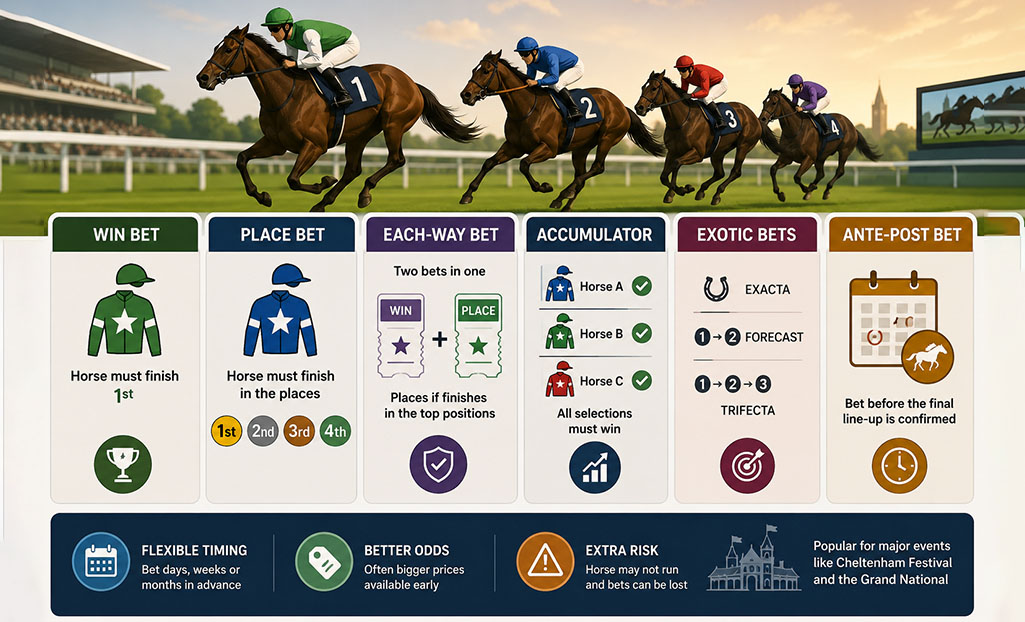
Comparison of the main horse racing betting types and how they work
Horse racing betting becomes much easier once you understand the most common bet types and when people usually use them.
Win Bet
A win bet is the simplest possible option.
Your horse must finish first for the bet to win.
Example
You place:
- £10 on a horse at 4/1
If the horse wins:
- You make £40 profit
- Plus your £10 stake returned
Total Return:
£50
If the horse finishes anywhere else, the bet loses.
Place Bet
A place bet means your horse doesn’t need to win the race. It only needs to finish within certain positions.
Depending on the race, bookmakers may pay:
- Top 2
- Top 3
- Top 4 places
Place bets usually offer smaller payouts, but they also carry less risk compared to win bets.
Example
You place:
- £10 place bet at 3/1
If the horse finishes inside the bookmaker’s place positions:
- The bet pays
If it finishes outside those positions:
- The bet loses
Each-Way Betting Explained
Each-way betting is one of the most popular betting styles in UK horse racing because it combines:
- A win bet
- And a place bet
Into one single wager.
An each-way bet is always:
- Two Bets
That’s the part many people miss at first.
Example of an Each-Way Bet
Let’s say you place:
- £5 each-way on a horse at 8/1
Your total stake is:
- £10
Because:
- £5 goes to the WIN part
- £5 goes to the PLACE part
Scenario 1 — The Horse Wins
Both parts of the bet win.
You get:
- Full win payout
- Plus the place payout
Scenario 2 — The Horse Places
The horse finishes:
- 2nd
- 3rd
- or another qualifying position
The win part loses, but the place part still pays.
That’s why each-way betting is extremely popular in races with many horses, like the Grand National.
Scenario 3 — The Horse Finishes Outside the Places
Both bets lose.
Example Betting Slip
- Race
3:15 Cheltenham
- Horse
Silver Crown
- Bet Type
£5 Each-Way at 8/1
- Total Stake
£10
Possible Outcomes
- Wins → both bets pay
- Places → place bet pays
- Outside places → loses
Accumulator Bets
An accumulator combines multiple selections into one bet.
Every selection must win for the accumulator to pay out.
Example
You choose:
- Horse A
- Horse B
- Horse C
If all three horses win:
- The accumulator wins
If one horse loses:
- The entire bet loses
Accumulators can produce very large payouts from small stakes, but they’re much harder to hit consistently.
Exotic Bets
Exotic bets involve predicting multiple race outcomes correctly.
These include:
- Exacta
- Forecast
- Trifecta
Example
A Forecast bet means predicting:
- Which horse finishes first
- And which horse finishes second
- In the correct order
Because these bets are harder to predict, the payouts can become much larger.
Ante-Post Betting
Ante-post betting means placing bets before the final race lineup is officially confirmed.
This often happens:
- Days before the race
- Weeks before major festivals
- Or even months in advance
The advantage is usually:
- Better odds
But there’s also extra risk.
If your horse doesn’t run, you may lose your stake depending on bookmaker rules.
Ante-post betting becomes especially popular before Cheltenham Festival and the Grand National.
How to Place a Horse Racing Bet Online
Most UK bookmakers follow the same process when placing a bet.
Step 1 — Choose a Licensed UK Bookmaker
Always use bookmakers regulated by the UK Gambling Commission.
This helps ensure:
- Secure payments
- Fair betting conditions
- Consumer protection
- Responsible gambling tools
Step 2 — Select a Race
Bookmakers display races by:
- Racecourse
- Time
- Country
- Race type
You’ll often find races running throughout the entire day.
Step 3 — Check the Odds and Market
Before betting, look at:
- Favourites
- Outsiders
- Market movement
- Each-way terms
- Track conditions
Odds often change before the race starts depending on betting activity.
Step 4 — Choose Your Bet Type
Decide whether you want:
- Win
- Place
- Each-way
- Accumulator
- Exotic bet
Your choice changes both:
- Potential payout
- Overall risk
Step 5 — Enter Your Stake
Before confirming the bet, always check:
- Total stake
- Projected payout
- Each-way split
- Number of selections
A lot of betting mistakes happen at this stage.
Step 6 — Confirm the Bet
Once confirmed, your betting slip becomes active until the race finishes.
Horse Racing Betting Strategies
There’s no strategy that guarantees winning bets every time.
But there are a few habits that help people manage risk better and avoid reckless betting decisions.
The 10% Betting Strategy
One of the most common bankroll strategies is the 10% approach.
The idea is simple:
- Never risk more than 10% of your betting bankroll on a single race
Example
If your bankroll is:
- £100
Your maximum stake per race would be:
- £10
This helps protect your balance during losing streaks.
Avoid Chasing Losses
One bad race often leads people into emotional betting.
That usually means:
- Increasing stakes too quickly
- Placing random accumulators
- Trying to recover losses immediately
Most of the time, that only makes things worse.
Pay Attention to Ground Conditions
Ground conditions matter a lot in UK horse racing.
Some horses perform much better on:
- Soft ground
- Heavy ground
- Firm ground
Ignoring track conditions can completely change how a race should be viewed.
Don’t Automatically Back the Favourite
Favourites win regularly, but not always enough to justify extremely short odds.
Sometimes better value exists elsewhere in the market.
Common Horse Racing Betting Mistakes
Even regular bettors still make these mistakes.
Betting Without Understanding the Payout
Always check:
- Potential return
- Stake amount
- Each-way terms
- Total exposure
Before confirming the bet.
Using Too Many Accumulators
Large accumulator payouts look exciting, but every extra selection dramatically lowers your chances of winning.
Ignoring Each-Way Terms
Different bookmakers offer different place terms, especially during major festivals.
That can make a big difference to potential payouts.
Betting Emotionally
Emotional betting usually leads to poor decisions and unnecessary losses.
As you can see, horse racing betting feels far less confusing once you understand what the odds and bet types are actually telling you.
And honestly, that’s when following the races becomes much more enjoyable.