Emotional Control in Betting: Avoiding Tilt

Chasing losses, betting out of FOMO, and becoming overconfident after a winning streak are the three most common psychological traps in sports betting.
In this guide, you’ll learn:
- Why emotional mistakes happen
- Real betting scenarios
- How to prevent tilt and impulse bets
- A practical framework you can use before every wager
Why Emotional Control Matters More Than Strategy
A disciplined bettor with an average system will outperform an emotional bettor with a “great” strategy.
Why?
Because emotional betting leads to:
- Increasing unit size impulsively
- Breaking bankroll rules
- Revenge betting
- Overexposure on one game
- Betting without analysis
Sports betting is a long-term probability game. Emotional betting turns it into gambling.
1. Chasing Losses: The Most Dangerous Habit
What Is Chasing Losses?
Chasing losses happens when you increase your bet size or place impulsive bets to recover money quickly after losing.
Typical thoughts:
- "I just need one big win."
- "There’s no way I lose again."
- "This next bet will fix it."
This mindset destroys bankrolls.
Every bettor remembers their first tilt session. Mine happened during an NBA playoff game. I was down 3 units. By halftime, I had doubled my stake. By the end of the night, I had burned 25% of my bankroll — not because my system failed, but because I did.
Real Example: How Bankrolls Collapse

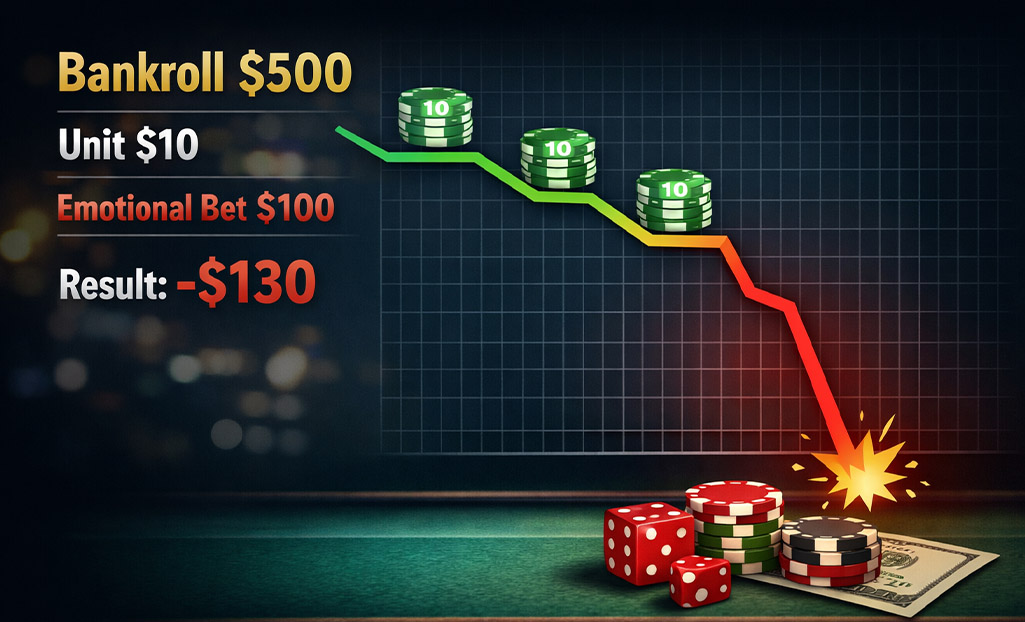
Example of how chasing losses and increasing bet size can quickly damage a betting bankroll.
- Starting bankroll: $500
- Unit size (2%): $10
- You lose 3 bets (-$30).
Instead of staying disciplined:
- You bet $100 on the next game.
If that loses:
- You’re down $130 instead of $30.
That’s emotional betting — not strategy.
Why the Brain Reacts This Way
Losses trigger:
- Ego damage
- Urgency
- Fear of falling behind
- Short-term thinking
This behavior is linked to loss aversion — a cognitive bias described by Nobel Prize winner Daniel Kahneman — where losses feel psychologically twice as powerful as gains.
How to Stop Chasing Losses
Chasing losses is not a discipline problem — it’s a reaction problem. When emotions take control after a losing streak, decision-making becomes impulsive and short-term focused.
Below is a simple, structured system you can apply immediately to prevent loss-chasing and protect your bankroll from emotional mistakes.
Step 1 – Fix Your Unit Size
Before you start betting, decide how much one unit is worth — and don’t change it based on how you feel.
Your unit should be 1–3% of your total bankroll.
Example:
If your bankroll is $1,000 and you use 2%, your unit is $20. That means most of your bets should be $20 — consistently.
Never increase your unit after a loss to "recover faster." That’s how small setbacks turn into big problems.
Consistency protects your bankroll. Emotion destroys it.
Step 2 – Set a Daily Stop-Loss
Example:
"If I lose 4 units in one day, I stop."
This prevents emotional spirals.
Step 3 – Use a 24-Hour Reset Rule
After a heavy loss:
- No betting
- No analysis
- No social media picks
Let emotions settle.
2. FOMO Betting (Fear of Missing Out)
What Is FOMO in Sports Betting?
FOMO betting happens when you place a bet just because:
- Everyone is talking about it
- It’s a major event (Super Bowl, NBA Finals, World Cup)
- Odds are moving fast
- Social media calls it a "lock"
- You didn’t calculate value.
- You didn’t compare odds.
- You just didn’t want to miss the action.
Why FOMO Bets Are Often Bad Bets
Public hype inflates odds. Sportsbooks adjust lines when too much money flows to one side. If everyone loves one team, that price may no longer offer value.
The 3-Question FOMO Filter
Before placing a bet, ask:
- Would I bet this if nobody was talking about it?
- Did I calculate implied probability?
- Does it fit my strategy?
If you hesitate — skip it. Skipping is a strategy.
3. Overconfidence After Winning
Winning streaks are emotionally dangerous.
After 4–5 wins, many bettors:
- Increase their unit size
- Bet more games
- Stop tracking results
- Believe they "figured it out"
Warning Signs of Overconfidence
- You stop respecting bankroll rules.
- You feel invincible.
- You bet games you didn’t fully analyze.
- You dismiss risk.
Why Your Brain Sabotages Your Bets
Sports betting doesn’t just test your strategy — it activates your brain.
When you place a bet:
- Dopamine spikes.
- Your brain reacts to the possibility of winning — not just the win itself.
- Anticipation creates excitement and urgency.
- As dopamine rises, impulse rises.
- Rational thinking drops.
That’s why tilt feels logical in the moment — even when it isn’t.
Then it gets amplified:
- A near-miss ("lost by one point") feels like you were right.
- You want to fire again immediately.
- Social media shows big wins and "locks."
- You rarely see losing streaks or negative ROI.
- Not betting starts to feel like missing out.
That’s the trap.
Recognizing these triggers gives you one edge most bettors don’t have: the ability to pause before emotion overrides strategy.
The Emotional Control Framework (Use Before Every Bet)
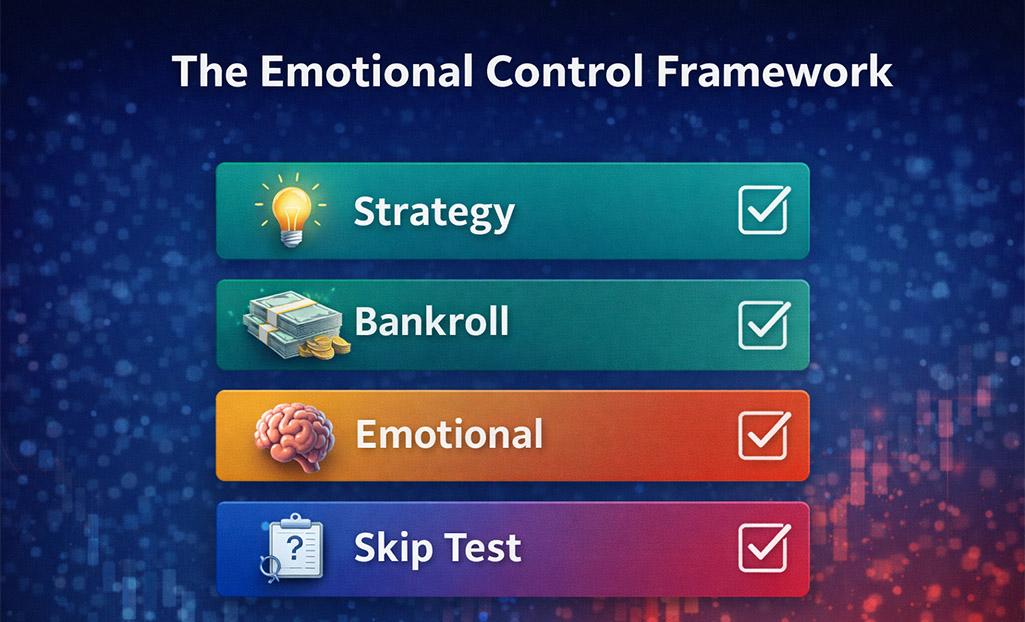
The 4-step emotional control framework to review before placing any bet.
Before you click "confirm bet," pause for a moment.
That’s why having a quick mental checklist can save you from impulsive decisions.
1. Strategy Check
Ask yourself: Does this bet actually fit my system?
Or am I placing it just because I like the team, the hype, or the matchup?
If it doesn’t match your strategy, it shouldn’t match your wallet.
2. Bankroll Check
Am I sticking to my normal unit size?
If you’re increasing your stake because you’re "feeling confident" or trying to recover losses, that’s a red flag. Discipline means consistency — not mood-based adjustments.
3. Emotional Check
Would I place this exact same bet if I hadn’t just won or lost?
If the answer changes depending on your last result, emotions are driving the decision.
4. The Skip Test
If I skip this bet, will I feel uncomfortable or anxious?
If not betting feels stressful, that’s not strategy — that’s emotion talking.
Emotional control isn’t about being perfect. It’s about catching yourself before small emotional decisions turn into expensive ones.
Practical Tool: The 60-Second Reset Method
Before confirming any bet:
- Step away from your screen.
- Take 5 slow breaths.
- Ask: "Is this decision logical or emotional?"
Emotional Self-Assessment
Answer honestly:
- Do I increase bet size after losses?
- Do I bet big games without research?
- Do I feel urgency after losing?
- Do I bet more after winning streaks?
- Do I struggle to skip games?
Emotional Discipline = Long-Term Survival
Most beginners focus on picks. Few focus on psychology.
If you master discipline:
- Your variance becomes manageable
- Your bankroll lasts longer
- Your decisions improve
- You avoid catastrophic sessions
Final Thoughts
Sports betting isn’t just about finding value — it’s about protecting yourself from your own impulses. The market will always offer another game, another line, another opportunity. What really separates consistent bettors from frustrated ones is patience and self-awareness.
Instead of asking, "Is this bet going to win?", start asking, "Am I making this decision for the right reasons?"
If you had to rate your emotional discipline today from 1 to 10 — what score would you honestly give yourself?