Horse Racing Bankroll: 10% Bank & 80/20 System

Backing a good horse means very little if poor bankroll management ruins the rest of your betting day. Horse racing moves quickly, and without some structure, it’s easy to increase stakes at exactly the wrong moment.
In this guide, you’ll see how both systems actually work, how to use them properly, and why they can make betting feel far less chaotic during busy racing days.
What Is a Horse Racing Betting Bank?
Your betting bank is simply the amount of money you set aside specifically for betting.
Instead of depositing money every time a race catches your attention, you work with a fixed bankroll and manage it more carefully over time. Think of it as your betting budget.
That structure matters a lot in horse racing because even strong favourites lose regularly, especially in competitive UK handicap races.
Example Betting Bank Sizes
How the 10% Betting Bank Strategy Works
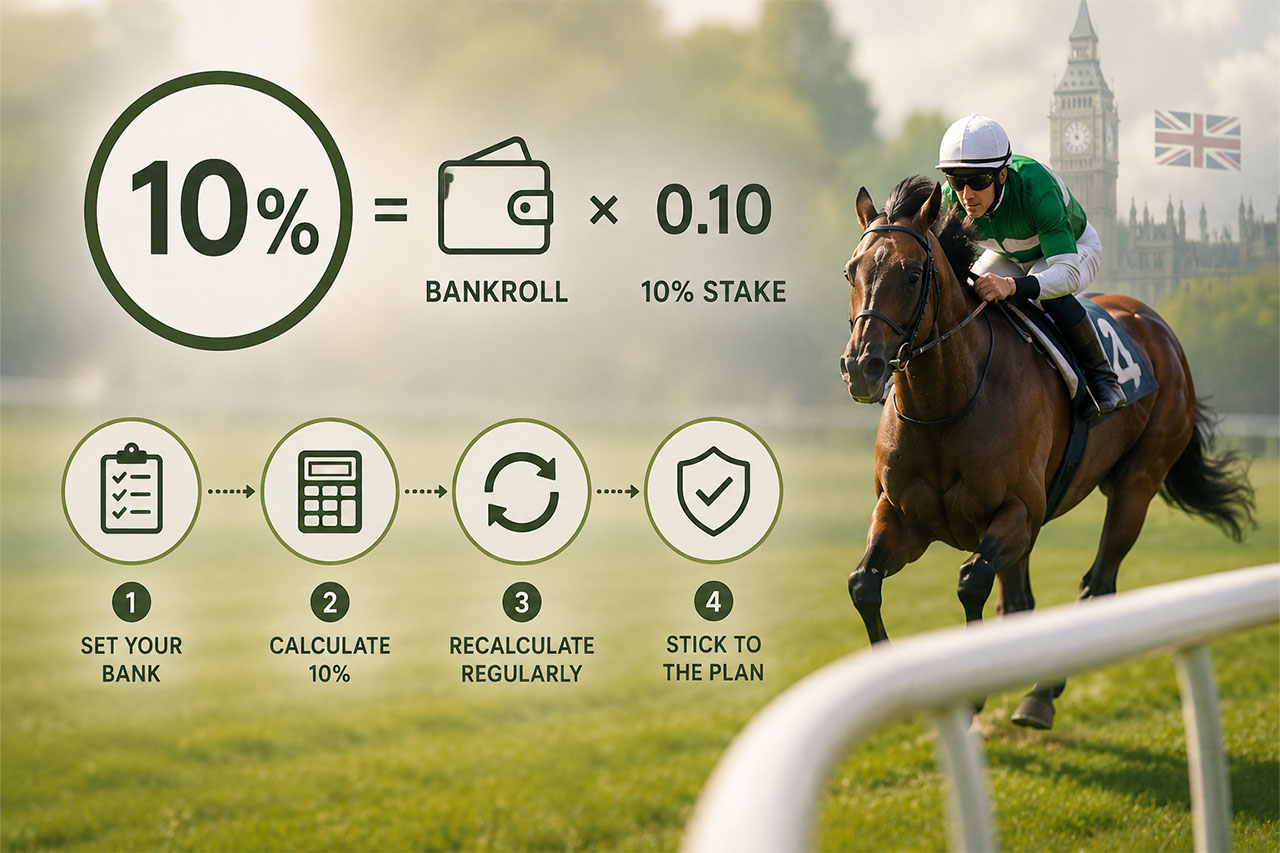
How the 10% betting bank strategy works in UK horse racing
The 10% bankroll strategy is one of the easiest systems to follow because the idea is very straightforward:
you only risk 10% of your current betting bank on a single race.
So if your bankroll is £200, your maximum stake becomes £20.
If your bankroll grows after a winning bet, your next stake increases slightly. If your bankroll drops after a few losses, your stake becomes smaller automatically.
That adjustment is one of the biggest reasons many bettors like this system. It naturally reduces risk during rough periods without forcing you to completely stop betting.
How To Apply the 10% Strategy
Step 1 — Set Your Betting Bank
Decide how much money you’re comfortable using purely for betting purposes.
Step 2 — Calculate 10%
Multiply your bankroll by 0.10 to find your maximum stake.
Step 3 — Recalculate Regularly
If your bankroll changes, your stake size changes too.
Step 4 — Stick To The Plan
That consistency is usually what makes bankroll strategies feel more controlled over time.
Understanding the 80/20 Betting System
The 80/20 system works a little differently.
Instead of placing your full stake on a horse to win, you split the stake:
- 80% goes on the horse to place
- 20% goes on the horse to win
Example 80/20 Stake Split
The idea behind this strategy is reducing volatility while still giving yourself a chance to profit properly if the horse wins outright.
And honestly, it makes a lot of sense in horse racing because plenty of strong runners place without actually winning.
A Simple UK Horse Racing Example
Imagine a horse running at 6/1 odds in a competitive Ascot handicap.
You decide to use a £20 total stake:
- £16 goes on the place market
- £4 goes on the win market
Now three different outcomes can happen.
If the horse wins
You collect returns from both bets, creating the highest possible profit.
If the horse finishes placed
You still recover money from the place portion, which softens the overall loss considerably.
If the horse finishes outside the places
Both bets lose.
That extra protection is exactly why some bettors prefer this approach during busy UK racing meetings where finding outright winners can feel unpredictable.
10% vs 80/20 System
Neither strategy guarantees profits, of course. They simply help create more structure around betting decisions.
Common Mistakes Worth Avoiding
Even good bankroll strategies stop working once discipline disappears.
Some of the most common mistakes include:
- Increasing stakes after losses
- Betting on too many races
- Ignoring bankroll limits
- Constantly changing strategy every few days
Keeping things simple usually works much better over time.
Conclusion
As you’ve probably noticed by now, bankroll strategies aren’t about removing risk completely. They’re about keeping your betting more controlled when horse racing starts getting unpredictable.
The good thing is that both the 10% betting bank strategy and the 80/20 system are simple enough to start using straight away.